At the Feet of Jesus
Reading the story of how Martha and Mary met Jesus after Lazarus died, I was always puzzled: why did Jesus react differently to their words? After all, they said exactly the same thing to the Lord: “Lord, if You had been here, my brother would not have died.” (Jhn.11:21)
But for some reason, in Martha’s case Jesus reproached her for unbelief. After Jesus said that her brother would rise again, she decided that it would happen not today but at the resurrection of the dead. So the Lord gave her the revelation that He Himself is the resurrection and the life, and then asked her: “Do you believe this?”
In Mary’s case, however, the Lord said nothing to her about faith or resurrection, but when He saw her weeping, and the Jews weeping, He Himself was deeply moved and troubled, and then He Himself wept.
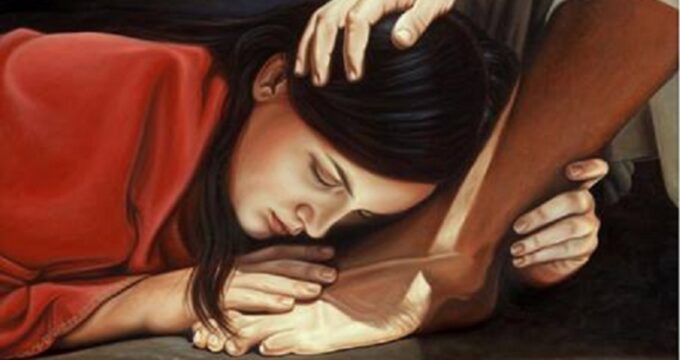
So, as I pondered this story, I thought that perhaps Jesus loved Mary more, since their words were the same; but then the Spirit of God drew my attention to a very “insignificant”, but as it turned out very important, detail: “Then, when Mary came where Jesus was, and saw Him, she fell down at His feet…” (Jhn.11:32)
Grace comes first
In the books of the old covenant there is a wonderful story about Ruth the Moabitess, who was the daughter-in-law of the Jewish woman Naomi. Naomi lived in a foreign country because there was a famine in Israel, and there she lost her husband and her two sons. When Naomi decided to return home, Ruth persuaded her to take her along.
When they came to Israel, Ruth said to her mother-in-law: “Please let me go to the field, and glean heads of grain after him in whose sight I may find favor.” (Rut.2:2) Very interesting words. Ruth did not say: “I’ll try very hard to serve and work, to earn our food.” She was not looking for a reward for her efforts and labours, but for the one in whose sight she would find favour.
The Hebrew word for favour is chen (H2580), and it literally means grace, favour or goodwill. The first time this word appears in Scripture is in the story of Noah, where it is written: “But Noah found grace in the eyes of the LORD.” (Gen.6:8) The word translated as grace is exactly this Hebrew word, chen.
When I had only just become a believer and was listening to a certain preacher, he said that Noah found grace with the Lord because he walked before Him. For some reason grace was presented as a deserved reward, but in the epistle to the Romans Paul writes: “And if by grace, then it is no longer of works; otherwise grace is no longer grace…” (Rom.11:6) That is, a person receives something from another person or from God either by works or by grace, that is, mercy. There is no third way.
Grace and works cannot be mixed, for they are like water and oil. As for the story of Noah, he walked before the Lord after he found grace. In other words, walking in faith, or before God, is the result of receiving God’s grace, not the other way round. After Noah found grace, it is written that he was a righteous man. Righteous not by works, but by faith, for by works no flesh is justified before God.
Of Noah it is written that by faith, being divinely warned of things not yet seen, he became heir of the righteousness which is according to faith. (Heb.11:7) And here is the sequence we get: first Noah received grace from God, then he believed, and only then did he walk before the Lord.
The apostle Paul writes to the Ephesians in the same sequence: “For by grace (1) you have been saved through faith (2), and that not of yourselves; it is the gift of God, not of works, lest anyone should boast. For we are His workmanship, created in Christ Jesus for good works (3), which God prepared beforehand that we should walk in them.” (Eph.2:8-10) Do you see this sequence? If a person does not receive grace, he cannot have faith, through which he gains the righteousness that is of faith; and without faith he cannot walk before the Lord and do good works. Sadly, in many places it is preached in the reverse order.
The place of rest and grace
Let us return to the story of Ruth. She went to glean, and “happened” (with the Lord nothing happens by chance) to come to the field of Boaz, who was a rich relative of her mother-in-law Naomi. Boaz showed favour to Ruth, ordered his young men not to touch her and allowed her to drink from the vessels his young men drank from. He also fed her with bread and told his young men to let her glean even among the sheaves. So she gathered a lot of barley.
When Naomi learned that Boaz favoured Ruth, she told her to go to Boaz, and when he had eaten and lain down to sleep: “you shall notice the place where he lies; and you shall go in, uncover his feet, and lie down; and he will tell you what you should do.” (Rut.3:4)
The word uncover here is very interesting, and since Boaz is an old covenant type of Jesus Christ, a revelation of Jesus is hidden here, or more precisely, a revelation of the place at His feet. In Hebrew, the language in which the books of the old covenant were written, the usual word for feet is regel (H7272), but here a different word is used — margelah (H4772). Literally this word means the place where the feet lie, so what Ruth was to uncover was the place at his feet.
So what is this place at the feet of our heavenly Boaz? It is the place of rest, for this verse says: “notice the place where he lies“. And when you uncover this place, or receive the revelation of God’s rest, then you yourself will lie down in this place and abide in His rest.
The epistle to the Hebrews says: “For he who has entered His rest has himself also ceased from his works as God did from His.” (Heb.4:10) When did Jesus cease from His works? When He said: “It is finished!” and completed the work of our salvation, healing, justification, sanctification and redemption. And when we believe that Jesus has already accomplished all this, we too enter God’s rest, abiding at Jesus’ feet. We rest in the faith that we are already saved forever, healed, justified and sanctified, for a great price was paid for us — the blood of the Son of God.
Interestingly, before Boaz lay down to sleep, he ate, drank, and his heart was cheerful. In the same way, before Jesus entered His rest, He tasted vinegar (the curses of the law), drank the cup of God’s wrath and made God’s heart glad, for He completed the work of our salvation.
The good part
When Jesus came to Martha’s house, Martha tried to please the Lord with her serving. Don’t we often do the same when we think that the Lord expects us to serve Him? But her sister Mary sat at Jesus’ feet and heard His word. (Luk.10:38-39)
Martha’s attempts to earn God’s favour with works and service ended with her getting angry with her sister and with the Lord. Martha accused the Lord of not caring that Mary had left her to serve alone. But Jesus answered her: “Martha, Martha, you are worried and troubled about many things. But one thing is needed, and Mary has chosen that good part…” (Luk.10:41-42) So what is this good part that Jesus spoke of?
Going back to the story of Ruth, we can read that before Naomi advised Ruth to lie down at Boaz’s feet, she said to Ruth: “My daughter, shall I not seek security for you, that it may be well with you?” (Rut.3:1) The Hebrew word translated security is manoach (H4494), and it literally means rest or a resting place.
In other words, Jesus was saying to Martha: “You are worried and troubled about many things, but only one thing is needed — to abide at My feet in the place of rest, and then you won’t be angry, but it will be well with you.” Why was Martha so troubled? Because she relied on her own works, not on the Lord and His grace.
Mary, on the other hand, relied on the Lord and therefore abided in rest at His feet. It was easy for her to receive Jesus’ grace, because Mary had nothing to boast of, for she was a sinner.
Grace for sinners
When Jesus came to Martha’s house, Mary brought an alabaster flask of fragrant oil, washed Jesus’ feet with her tears and wiped them with her hair. (Luk.7:36-38) The Gospel of Luke says that Jesus came to a Pharisee’s house. I believe this Pharisee was Martha’s husband, whose name was Simon. The Gospel of Mark says that when Jesus sat at the table in the house of Simon the leper (in Bethany), a woman (Mary) came with an alabaster flask of fragrant oil. (Mar.14:3) It is the same story as the one described in the Gospel of Luke, only from another angle.
As Mary was washing Jesus’ feet, the Pharisee thought to himself: “If this man were a prophet, he would know who is touching him, for she is a sinner.” But Jesus, perceiving in His spirit what Simon was thinking, told him a story about two debtors. One of them owed his master 50 denarii and the other 500, and since neither of them had anything to repay with, he forgave them their debts.
Then Jesus asked the Pharisee: “Tell Me, therefore, which of them will love him more?” “The one whom he forgave more,” Simon answered. Jesus said: “You have rightly judged.” That is exactly why this woman loves more — because she has been forgiven more; and to whom little is forgiven, the same loves little. And in conclusion Jesus said to the woman: “Your sins are forgiven.” (Luk.7:42-48)
How do we receive the forgiveness of sins? By grace! In the epistle to the Ephesians the apostle Paul writes: “In Him we have redemption through His blood, the forgiveness of sins, according to the riches of His grace“ (Eph.1:7) Our forgiveness does not depend on our exemplary behaviour, on the depth of our remorse or on our confession. Our forgiveness depends entirely on the riches of His grace.
And the more a person realises the magnitude of God’s forgiveness, the greater the riches of grace he receives. If he is forgiven little, a person receives little grace, and if much, then much. And the more grace a person receives, the more he believes and abides in rest at Jesus’ feet, and the greater the praise and the blessing he receives from the Lord.
Walking in faith
Jesus was passing between Samaria and Galilee and met ten lepers on the way, who cried out from afar: “Jesus, Master, have mercy on us!” He said to them: “Go, show yourselves to the priests,” and as they went, they were cleansed. “And one of them, when he saw that he was healed, returned, and with a loud voice glorified God, and fell down on his face at His feet, giving Him thanks. And he was a Samaritan.” (Luk.17:11-16)
Then Jesus said: “Were there not ten cleansed? But where are the nine?” The thing is that the nine were Jews, and they thought they had received their cleansing (healing) not by mercy but as their due, for they lived under the law. They thought that they were part of God’s people (righteous by the law) and therefore deserved healing. But the Samaritan was a foreigner, like Ruth, and by the law a sinner, so he relied not on his own works but on God’s grace. And what was the result?
Jesus said: “Arise, go your way. Your faith has made you well.” The Samaritan began to walk in the faith and salvation of the Lord, like Noah. Noah first found grace in the eyes of the Lord and then began to walk before the Lord. The nine leper legalists saw the Lord only from behind (the place of God’s law and wrath) when they cried out for mercy (Luk.17:12), but the Samaritan sinner, abiding at Jesus’ feet, saw the grace and glory of God in the face of Jesus Christ!
When we behold the glory of the Lord, as in a mirror we are transformed into the same image from glory to glory. The Spirit of God makes us like Jesus, and we begin to do the works of God, which God prepared in Christ Jesus from the foundation of the world. Amen!
“There, at the feet of the heavenly Boaz, you will hear what He tells you to do.” (Rut.3:4)
faith, grace, Jesus, rest, worksLeave a Comment
| 🙂 | 🙁 | 😄 | 😎 | 😉 | 😮 | 😢 |
| 😰 | 😐 | 😘 | 🤭 | 😛 | 😝 | 😳 |
| 🥴 | 😴 | 😲 | 🥱 | 😍 | 🥰 | 💗 |
| 😟 | 😠 | 🤓 | 🤐 | 😷 | 🤔 | 😇 |
| 👍 | 👎 | 💪 | 👏 | 🌞 | ⛪ | 🙏 |
| ⏱ | 🎵 | 🎧 | 🌻 | ⭐ | 🍰 | 🥳 |